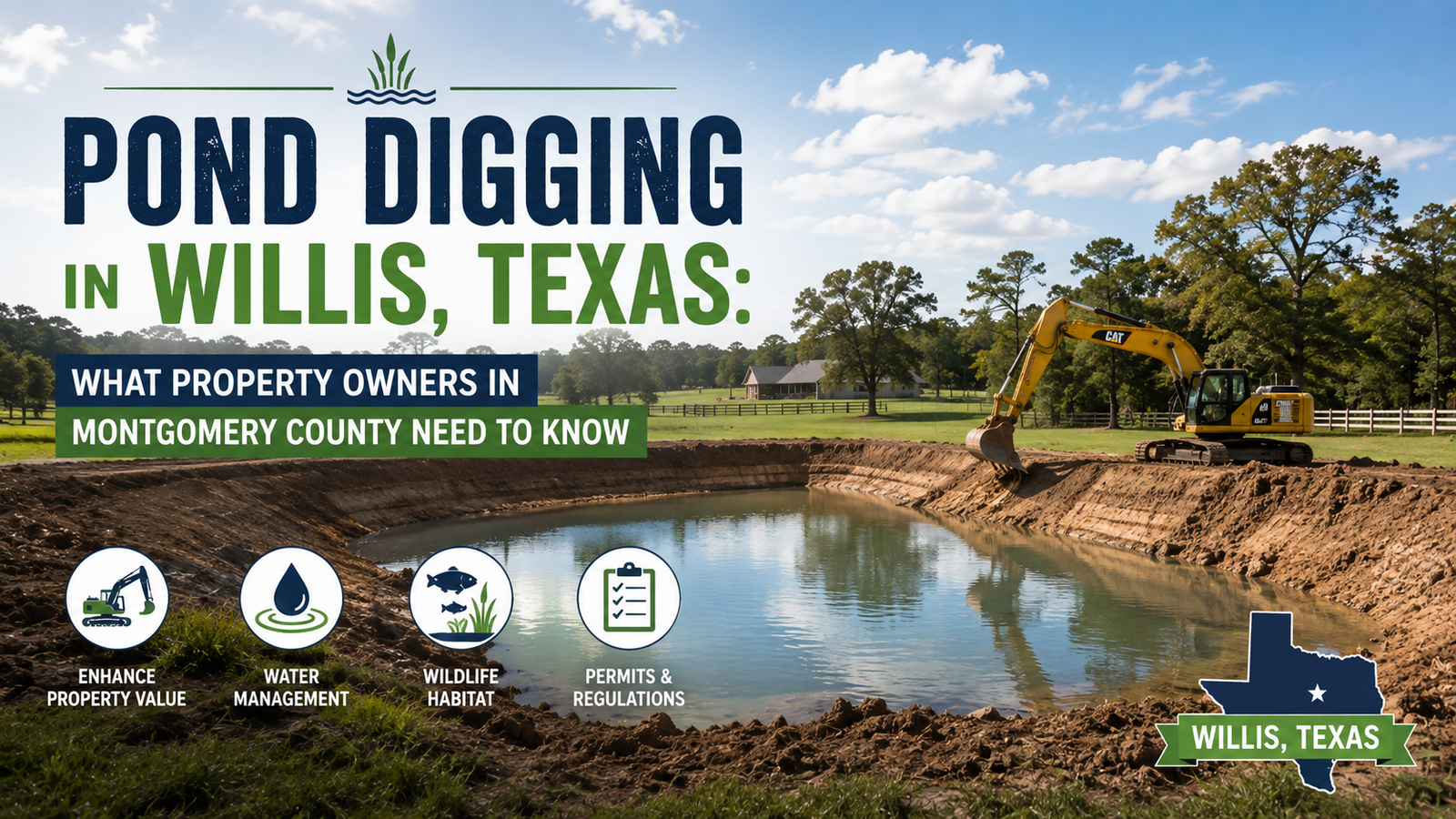
Willis, Texas sits in one of the most pond-friendly landscapes in the American South. The northern Montgomery County area combines the high annual rainfall of East Texas, the clay-dominant soils that make natural water retention possible without synthetic liners in many situations, the flat-to-gently-rolling topography that identifies natural low areas suitable for pond placement, and a culture of rural land ownership where stock tanks, bass ponds, and recreational water features have been part of the landscape for generations. For the many property owners throughout Willis and surrounding areas who are considering pond construction whether for livestock watering, recreational fishing, stormwater management, wildlife habitat, or aesthetic enhancement understanding what Pond Digging Willis actually involves, what makes a successful pond in the East Texas environment, and what the regulatory landscape looks like is the essential foundation for any successful project.
Why Willis and Montgomery County Are Well-Suited for Ponds
Three characteristics of the Willis area make pond construction more practical and more successful here than in many other parts of the country.
Clay soils are the most important factor. The heavy clay that underlies much of northern Montgomery County is highly impermeable water does not readily pass through it. This impermeability is precisely what a pond needs to retain water without requiring a synthetic liner. A pond excavated into naturally occurring clay at the Willis site will hold water through its clay bottom and sides without the expense and installation complexity of a synthetic liner that would be necessary on a sandy or gravel site. The clay is Willis’s most significant natural asset for pond construction, and experienced pond diggers in the area know how to assess clay quality, set appropriate excavation depth to reach consistent clay, and prepare the pond basin to maximize water retention.
Annual rainfall of approximately 50 inches provides consistent pond replenishment. Willis-area ponds fed by natural watershed runoff from their surrounding drainage area maintain water level through all but the most severe droughts, and many refill quickly after partial drawdown when the next rain event arrives. The rainfall pattern also creates the natural drainage pathways the low spots that collect runoff from surrounding higher ground that make the selection of pond sites straightforward on most Willis properties.
The acreage character of many Willis-area properties provides the space needed for productive pond construction. A bass fishing pond needs depth a minimum of 8 to 10 feet in the deepest zone to maintain water temperatures that support healthy fish populations through East Texas summers and area, typically at least a quarter acre and ideally half an acre or more for quality bass fishing. Willis-area properties, many of which are 5 to 50 acres or more, have room for properly sized ponds that can support meaningful recreation and water management functions.
Types of Ponds Built in the Willis Area
Property owners in Willis and Montgomery County pursue pond construction for several distinct purposes, and the design requirements vary by purpose.
Recreational fishing ponds often called bass ponds or farm ponds are the most common pond type requested on Willis-area residential and rural properties. A properly designed fishing pond in East Texas has a depth gradient that provides cool, oxygen-rich water in the deep zone (8 to 12 feet is the typical design target for bass ponds in this climate), shallower marginal zones that support aquatic vegetation and serve as fish spawning habitat, and a surface area adequate to allow largemouth bass populations to grow to trophy size. The design of a fishing pond must account for fish stocking ratios the balance between bass, bluegill bream, and supplemental forage species that produces a self-sustaining fishery and for long-term management including periodic fertilization, vegetation management, and supplemental feeding.
Stock tanks and livestock watering ponds are functional water features that provide reliable water access for cattle, horses, and other livestock on agricultural properties throughout the Willis area. Stock tanks are designed for reliable water volume rather than maximum depth or fish habitat, with a focus on watershed management to ensure consistent water level, inlet protection to prevent erosion from incoming runoff, and outflow management to prevent dam failure during high-rainfall events.
Stormwater detention and retention ponds address the drainage management requirements of many Willis-area properties, particularly those adjacent to developed areas or on low-lying land that receives runoff from surrounding properties. A properly designed detention pond provides temporary storage for storm runoff, releasing it slowly after the rainfall event to reduce downstream flooding. Montgomery County’s stormwater regulations require detention for certain development activities, and voluntary detention pond construction can be a practical tool for managing water on properties where runoff from adjacent land creates flooding or drainage problems.
Aesthetic water features smaller ponds incorporated into landscape design for visual interest, wildlife habitat, and the ambiance of water on residential properties are a growing category in the Willis-area rural residential market. These features may be quarter-acre to full-acre ponds designed primarily for visual appeal and wildlife value, often stocked with ornamental species or small bass and perch populations for casual fishing interest rather than trophy fishing management.
The Pond Digging Process in Willis
Pond construction in Willis begins with a site assessment that evaluates the potential pond location for suitability. The assessment considers the natural drainage area that will feed the pond (the watershed area), the existing topography and depth to clay (to confirm that excavation will reach the clay layer needed for water retention), the presence of any existing drainage features that would be incorporated into or affected by the pond, and any regulatory considerations (proximity to waterways, wetlands, or property boundaries).
The dam design the earthen embankment that closes the low end of the pond basin is the most engineered component of most farm pond construction in East Texas. A pond dam must be designed with adequate height, width, and side slopes to contain the water without failure under normal rainfall conditions, and it must include an appropriately sized principal spillway (a pipe or box structure that releases water at a defined water level to maintain the design depth) and an emergency spillway (an overflow pathway that handles flows that exceed the principal spillway capacity during major storm events). A dam that fails during a storm event can release the full pond volume in a matter of minutes, with potentially catastrophic consequences for downstream property and life safety.
Excavation of the pond basin uses tracked excavators matched to the project scale. The excavation must reach the clay layer consistently across the pond bottom and sides to ensure water retention. Areas where sand or gravel lenses are encountered within the clay profile may require special attention these permeable zones can allow water to escape the pond even when the surrounding clay is otherwise intact. Experienced Willis-area pond contractors identify these conditions during excavation and address them through puddle clay treatment or targeted compaction.
The clay excavated from the pond basin is the material used to construct the dam. This excavated clay is placed in compacted lifts typically 6 to 8 inches of loose material compacted to at least 95 percent of maximum standard Proctor density to build the dam to design height and width. The quality of dam construction directly determines the dam’s long-term integrity and water-holding reliability.
After the basic pond and dam construction is complete, the pond typically needs three to six months to fill naturally from watershed runoff and rainfall before being stocked with fish or put to its intended use. During this filling period, the exposed earthen dam faces and pond banks should be seeded with erosion-resistant grasses bermudagrass and bahiagrass are commonly used for Willis-area pond slopes to protect the bare soil from rainfall erosion while the pond fills.
Texas Regulatory Framework for Pond Digging in Willis
Pond construction in Texas is subject to multiple overlapping regulatory considerations that property owners must understand before beginning construction. The Texas Commission on Environmental Quality (TCEQ) regulates certain types of dams under the Texas Water Code, particularly for impoundments above specific size thresholds. Small farm ponds below the TCEQ regulatory thresholds which cover ponds with dams below a certain height and impoundments below a certain volume can generally be constructed by private landowners without TCEQ dam safety review, though TCEQ registration may still be required.
The U.S. Army Corps of Engineers has jurisdiction over activities in navigable waters of the United States and their tributaries, including the placement of fill material in jurisdictional waters and wetlands. Pond construction that involves filling jurisdictional wetlands or altering a waterway may require a Section 404 permit from the Corps. In Willis and Montgomery County, where numerous small streams, oxbow lakes, and seasonally wet areas exist throughout the landscape, determining whether a proposed pond location involves jurisdictional features is an important pre-construction step. A wetland delineation by a qualified professional can clarify the regulatory status of a site before construction begins.
Common Questions About Pond Digging in Willis
How big should a fishing pond be for good bass fishing on a Willis-area property? Fisheries biologists generally recommend a minimum of one-quarter to one-half acre for a functional bass pond, with half an acre or more providing better conditions for trophy-size bass production. Depth is equally important the deepest zone of the pond should reach 8 to 10 feet to provide the thermal refuge that bass need during East Texas summers.
Do I need a permit to dig a pond on my Willis, Texas property? For small farm ponds on private land, many situations do not require a formal permit, though TCEQ registration may be required for certain impoundment types. Any pond construction that affects a waterway, wetland, or jurisdictional water requires evaluation for Corps of Engineers Section 404 permit requirements. Larger dams may require TCEQ dam safety review. Consulting with your contractor and potentially with TCEQ and the Corps before construction begins is advisable.
How long does it take to dig a pond in Willis? Pond construction timeline depends on pond size, dam design complexity, and equipment availability. A typical half-acre pond with a simple earthen dam in Willis can usually be excavated and constructed within one to two weeks of equipment mobilization. Larger or more complex ponds take proportionally longer.